

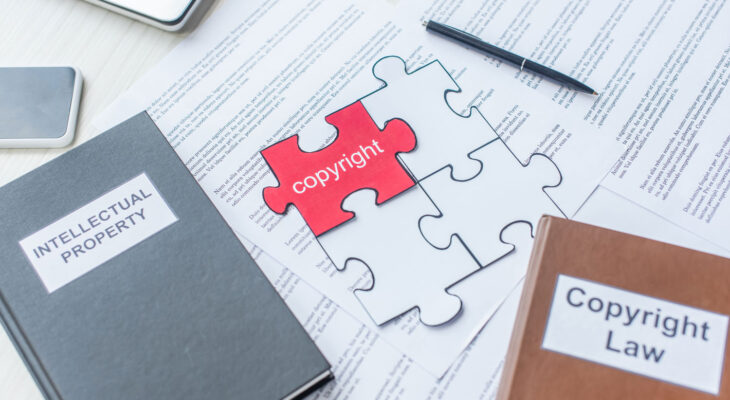
Copyright law protects many kinds of works such as those that are written, drawn, photographed, recorded, or performed. The only requirement is that they have an element of creativity and are not purely factual. The right to distribute, reproduce, and adapt a copyrighted work resides with the copyright holder. However, user rights exist that allow instructors to use copyrighted material in their classrooms. These rights can be more restrictive in online courses than in face-to-face courses.
It is important to consider copyright law in online course creation. If third-party content (i.e., content that was created by someone other than you) is used in a way that does not comply with copyright law, it could be taken down (disrupting the course), the unit could be forced to pay a fee for the use, or litigation could result.
In Practice
Imagine these situations:
- You have a brief movie clip you’d like to use in your class as a way to illustrate a concept.
- You found an image online that does a great job illustrating the cycle of poverty and you’d like to include it in your lecture slides.
- You have an article you’d like to share with your class. Typically, you would upload a PDF to Canvas for your students.
These are just a few of the many ways that third-party content is used in courses Especially in online courses, instructors and learning experience designers must carefully consider whether their use is allowed under copyright law.
Instructors and design teams can help avoid potential risks by asking the following five questions for each piece of third-party content they consider using in their course:
1. Are there contractual terms, terms of service, or terms of use that limit my use?
Before using any piece of content you find online, you check to see if any contractual terms (e.g., the terms of service) might affect the use you want to make. By accessing most websites, you agree to abide by the terms of service, even if you haven’t read them or were unaware they existed. Ultimately, it is for you to decide whether to follow the terms you’ve agreed to or try to negotiate a different set of contractual terms. If you ignore contractual terms, remember that there may be legal consequences outside of copyright law.
If the answer to this question is yes, move to question five. If the answer to this question is no, move to question 2.
2. Is the third-party content uncopyrightable or in the public domain?
Copyright does not protect everything. Some things are fundamentally not copyrightable. For instance, copyright does not protect any idea, procedure, process, system, method of operation, concept, principle, or discovery. To be protected by copyright, the work needs to embody some spark of creativity and not be purely factual. Works that are not protected by copyright can typically be used without any restrictions; however these works may be subjected to other protections outside of copyright.
This is especially important when you want to use third-party content like charts and graphs in your course. If the chart is not copyrightable, it can be used freely because there are no copyright restrictions.
Some third-party content is no longer protected by copyright, either because the copyright term has expired or because the copyright holder has dedicated the work to the public domain. All works published in the U.S. more than 95 years ago are in the public domain. Works published before 1989 could also be in the public domain for not following formalities that were required at the time. Consult Cornell’s Copyright Term and the Public Domain in the US chart to see if the third party content you want to use might fall into this category of works.
If the third-party content is uncopyrightable or in the public domain, stop here; you can freely use that content. If not, move to question three.
3. Is the third party content already licensed for my use?
Your use of a copyrighted work may be covered by a pre-existing license. The most common type of public license is the Creative Commons (CC) license. CC licenses are blanket licenses that give everyone the ability to use the content as long as they follow the rules outlined by the copyright holder. All CC licenses require attribution. More details can be found in the Center for Academic Innovation’s (CAI) How To: Attributions guide.
There are also online resources that the University of Michigan (U-M) library has already purchased. If your online course is for registered U-M students only, you can take advantage of these resources by providing students with the link to the resource (commonly, ebooks and journal articles, but also some other types of media) in the library’s catalog. This will authenticate the student and allow them to view the resource.
For more information about what library resources may be available for your course, contact your subject specialist librarian.
If the third-party content is already licensed for your use, stop here; you can freely use the content as long as you follow the scope of the license. If the third-party content is not already licensed, or if you’d like to use it outside the scope of the license, move to question four.
4. Is my use of third-party content a fair use?
There may be some third-party content you want to use that is protected by copyright and isn’t already licensed. If there is no adequate replacement and the third-party content is crucial to the course, you should consider whether the use is a fair use. If the use is a fair use, the third-party content can be included in the course without permission.
Fair use is a user’s right that encourages certain favored uses (like criticism, commentary, and education) without the permission of the copyright holder. Fair use is context specific; there are no bright line rules. For example, it’s a widely believed myth that 10% of a work can be used under fair use. This is not always true. Sometimes, using 10% of a work is not a fair use. Sometimes, using 100% of a work is a fair use. It is very dependent on the specific use you are making.
For each fair use analysis, consider the following four factors:
- The purpose of the use;
- The nature of the copyrighted work;
- The amount used; and
- The effect on the market.
For more information about fair use and some helpful guidance on how to apply the fair use analysis, consult the U-M Library Copyright Office’s Fair Use page.
If your use of the third-party content is a fair use, stop here. If not, move to question five.
5. Can I ask for permission to use the third-party content?
If the third-party content is copyrightable, not already licensed, and your use would not be a fair use, you should ask the copyright holder for permission to include the content in your course. Third-party content can be used in any way if the copyright holder gives you permission to make those uses.
When asking for permission, make sure you’re clear about how the material will be used, how many people will view it, and how long the content will be used. This will help the copyright holder make an informed decision on whether or not they want to allow the use and how much they want to charge for it (if at all). Although not legally required, it is a good idea to get the permission and terms in writing and save the writing for future reference.
The U-M Library Copyright Office has a Sample Permission Letter that can easily be adapted to fit the needs of your specific course. More information about requesting copyright permission can be found in the Obtaining Copyright Permissions research guide.
If you cannot ask for permission to use the work or if the copyright holder says no, you should not include the work in your course. Instead, try looking for a replacement that’s available under an open license. CAI’s guide on Finding Usable Materials is a helpful place to start.
Practical tips
The copyright team at CAI is available if you have questions or would like to learn more about how copyright affects what you use in your course. They can be contacted at [email protected].
Resources
- How to flip your content: Designed for those building MOOCs, this document can help you find additional open education resources
- Finding usable materials
- Open Educational Resources