Beyond Lectures: Virtual Production for Instructional Videos
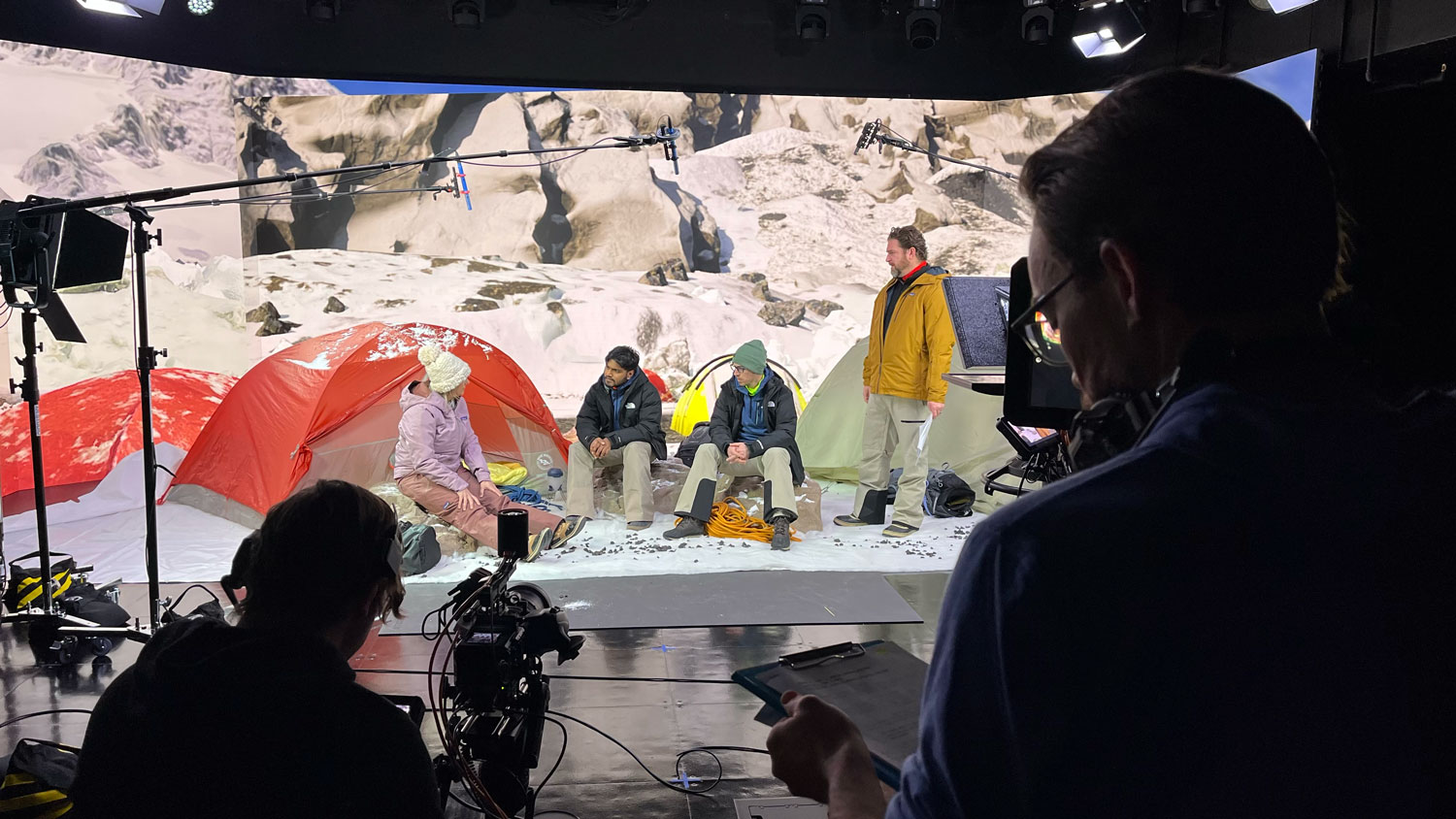
Explore the tense and treacherous trails of Mount Everest, or the calming and serene beauty of the Nile River. Visit the halls of the Detroit Institute of Art, or settle onto a comfy cushion at a meditation studio.
Near or far, vast or small, any location is ripe for lessons, learning, and growth inside the Extended Reality (XR) studio at the University of Michigan Center for Academic Innovation, which currently offers five uniquely different virtual production formats geared toward enhancing traditional lectures and the professor-student relationship.
The center partnered with a number of U-M faculty seeking ways to enhance their learning outcomes and provide students with immersive and lifelike experiences they otherwise would not be able to access. For example, joining a Mount Everest climbing expedition to simulate life-or-death medical decisions in high-pressure and high-stakes environments.
XR and Virtual Production Formats
| Formats | Use Case | Minimum Timeline |
| 2D Backplate Production | For presentations, lectures, and interviews using static backgrounds with no 3D interaction. | 3 Days—1 day for background sourcing, 1 day for studio setup, and 1 day for production. |
| 2.5D Backplate Production | Adds layered 2D images to allow slight camera movement and visual depth for presentations or simple scripted scenes. | 4 Days—2 days for background sourcing and preparation, 1 day for setup, and 1 day for production. |
| 3D Backplate Production | Uses sourced or custom 3D environments to support dynamic single or multi-camera setups, providing basic spatial immersion for presentations and storytelling. | 6 Weeks—2 weeks for concept development, 2 weeks for environment creation or sourcing, 1 week for testing and setup, and 1 day for production. An additional 2 weeks may be allocated for post-production 3D rendering if required. |
| 3D XR-Interactive Production | Fully immersive virtual sets with AR graphics, animations, overlays, set extensions, and interactive elements. Ideal for high-engagement teaching and dynamic presentations. | 9 Weeks—3 weeks for concept development, 3 weeks for environment creation or sourcing, 1 week for interactive animation and system integration, 1 week for testing and setup, and 1 day for production. An additional 3 weeks may be allocated for post-production 3D rendering if required. |
| Cinematic Virtual Production | Combines real-time 3D environments or 2D backplates with camera tracking, physical props, and actors to deliver story-driven, cinematic instructional experiences. | 4 Months—Approximately 2 months for concept development, scripting, and planning; 1 month for environment creation, sourcing, animation, casting, and prop development; 2 weeks for testing and setup; and 1-3 days for production. An additional 4 weeks may be allocated for post-production 3D rendering if required. |
Barbara Medvec, a clinical associate professor at the School of Nursing, is one of the instructors embracing this visually stunning technology—which filmmakers in Hollywood utilize in big-budget productions such as “The Mandalorian” and the most recent “Avatar” pictures—for online learning.
“My perspective in creating the overall XR Experience was that it fundamentally changed how I think about online teaching,” Medvec said.
She, and her colleague Michelle Aebersold, a School of Nursing clinical professor and clinical associate professor in the School of Information, brought their in-person interactive simulation, “Navigating Team Dynamics in Extreme Environments,” to the virtual production team at CAI with visions of enveloping learners (in this case, nursing students) in a dangerous summit attempt of Mount Everest.
The Everest experience is an example of a Cinematic Virtual Production, the largest such undertaking offered by CAI and one which requires a production timeline upwards of four months. But, not every lesson demands an Everest-sized scope and scale. Cheri Alexander, a faculty member at the Ross School of Business, envisioned the studio as an opportunity to transport her classroom—and her students—an hour away to Detroit and around the globe to Egypt for lessons in her course series, “Extraordinary Human Capital Management.”
The result was a self-described “excellent experience” working with the center’s production team and spot-on recreations of the Detroit Institute of Art and Nile River in Egypt.
“I believe this significantly enhanced the learning experience, as it helped simulate the places where the stories I was sharing originally unfolded. These visual settings create vivid mental images that deepen engagement and understanding as learners move through the course,” Alexander said.
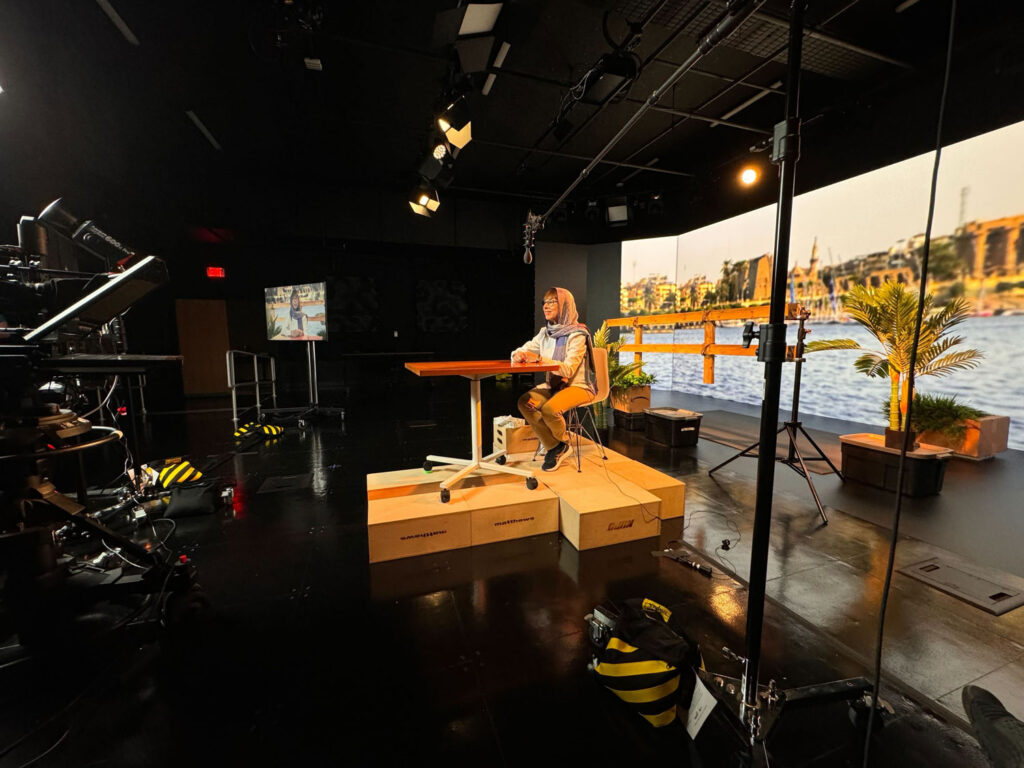
From a production and time-commitment standpoint (typically three days, beginning to end), this form of virtual production, known as a 2D Backplate Production, utilizes everything from generative AI, video plates, stock videos, motion graphics and more to create new environments or, in the case of Alexander’s lesson, recreate a particular location with the intent of visually captivating the learner and aiding their engagement.
“Whether exploring the vacuum of deep space, prehistoric landscapes, or hazardous simulations, XR and VP application in education allows an instructor to be physically immersed in the subject matter. This eliminates the barriers of distance and danger, fostering deeper learner engagement and sparking a sense of curiosity that traditional classroom settings cannot match,” said Chiemela Mgbeahuru, virtual production producer at the center.
Slightly more time consuming, 3D Backplate Productions, like the ones utilized in the course series “Mindfulness, Dignity, and the Art of Human Connection,” take roughly six weeks to complete production. This format utilizes sourced or custom 3D environments to support dynamic single or multi-camera setups, adding a visceral layer to presentation and storytelling.
Kameron Donald, media designer senior at the center, not only filmed the instructional videos for the series, but found himself enlightened by the benefits of mindfulness and meditation on one’s mental health. The effectiveness of the deeply engaging experience was powerful.
“Professor Ram (Mahalingam) taught people how to think through life situations, how to process your thoughts and have calmness,” Donald said. “It covers a lot of things that people face on a day-to-day basis.”
Additional Benefits of XR and Virtual Productions
The ability to produce “on-location” videos without actually being ON location avoids prolonged shoots due to inclement weather and distractions (i.e. interruptions from curious bystanders), which cause breaks in filming, exhaustion and stress for faculty and crew, and, potentially, additional financial burden to the overall production.
“When I consider the comparison of the power of in-person simulations which can be powerful because of physical presence and live interaction, I also understand that they are limited by cost, scheduling, and scalability. Only a small number of learners can participate, and the experience varies widely from session to session,” Medvec said, adding, “XR allowed us to move beyond content delivery into experience design. Instead of asking learners to imagine leadership under pressure, we placed them inside it—cognitively, emotionally, and ethically.”
Mgbeahuru sees the educational impact of virtual instructional videos in a similar fashion to traditional storytelling and news delivery.
“Consider why meteorologists and reporters stand directly in the path of a hurricane. By filming intense weather in real-time, they provide a visceral sense of being there, helping viewers grasp the gravity of the situation through the correspondent’s perspective,” he said. “Virtual production and XR technologies bring this same on-location power to education.”
Raising the Bar of Online Instruction
Ringing endorsements aside, these production styles are an added lift for faculty, which begs the question: Why should they go to these lengths (arguably massive lengths) to teach a lesson previously contained to a classroom or lecture studio?
“The ability to create an immersive experience that blends storytelling, crisis under pressure, and team dynamics allows the learner to get a profound experience that goes beyond what we can do in a simulation lab,” said Aebersold. “Bringing nursing faculty together with media experts and software designers was an amazing experience and allowed us to push the boundaries of what is possible,” she added.
Medvec perhaps best sums up the impact of XR and virtual production on instructional videos.
“XR raised the bar for me as a faculty [member] and it forced us to ask: What do we actually want learners to feel, notice, and decide at this moment? That question improved the entire course offerings and not just the immersive component.”