Virtual Reality Tool Transforms Concussion Course
Development of immersive experience helps train students in real-world scenarios
How this will help
Ben Luu is an economics major at the University of Michigan College of Literature, Science, and the Arts. He served as a Center for Academic Innovation Student Fellow during the summer of 2025.
What began as an idea to help students practice diagnosing concussions became an exciting project developed at the Center for Academic Innovation, which has since resulted in a virtual reality (VR) tool that gives University of Michigan students valuable hands-on experience.
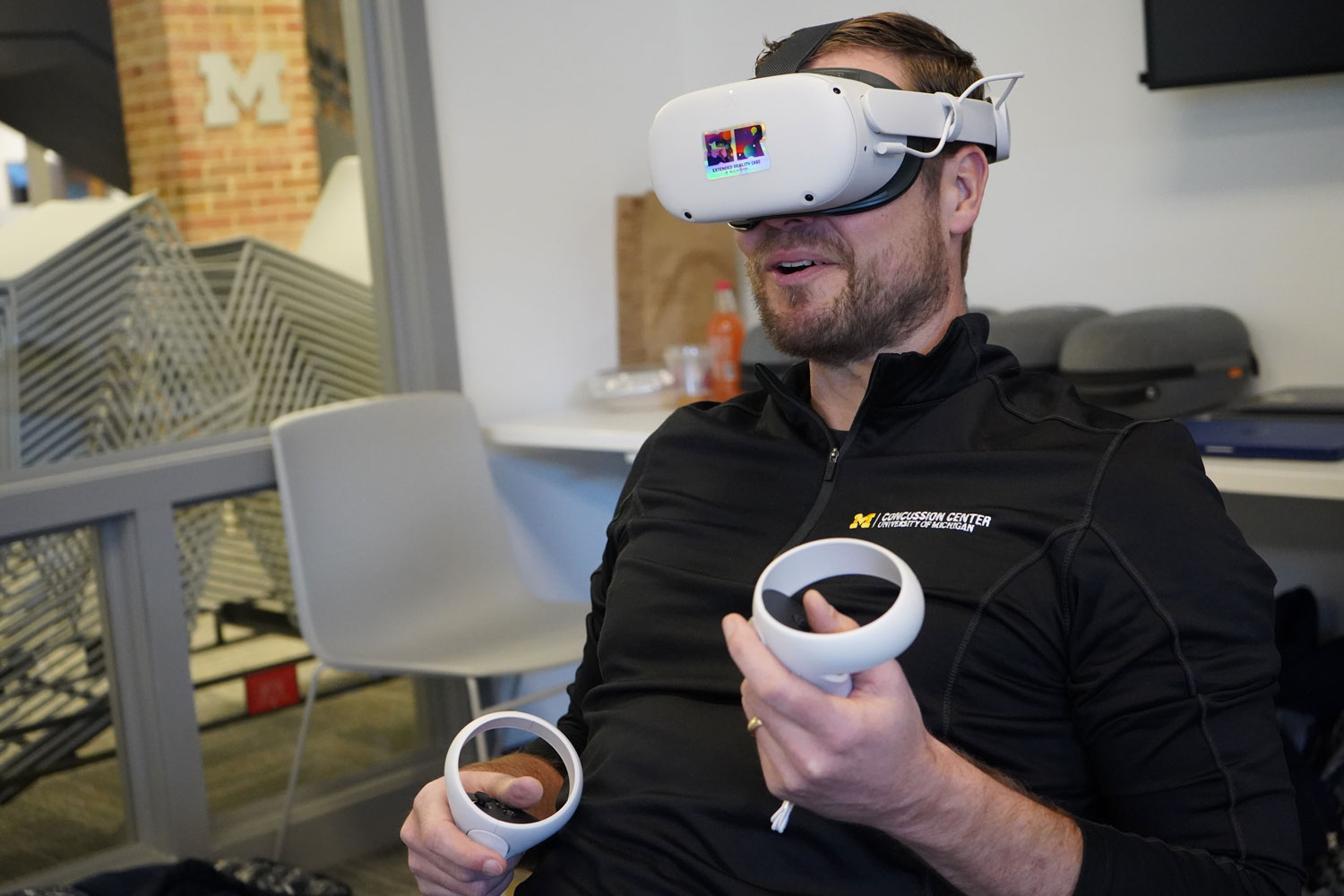
In collaboration with the Concussion Center of the School of Kinesiology, the Extended Reality team at CAI turned that idea into “Inside The Mind: Exploring Concussions,” a VR headset experience that simulates a medical check-up. Using the Sport Concussion Assessment Tool 6 (SCAT6), the students practice identifying the ways symptoms can present themselves in different patients. The students’ objective is to use the protocol to determine the appropriate diagnosis for the simulated patient. “Inside The Mind” immerses the students in a clinical setting, giving them a space to practice and apply the concepts they have learned in the classroom.
“The VR environment is a safe space for them to practice what they learn in the classroom, so they will have more experience and confidence when they need to do it on the sideline or in a clinic,” said Dr. Steven Broglio, director of the U-M Concussion Center and professor of kinesiology, neurology, and physical medicine.
What is XR?
XR is an umbrella term encompassing technologies that combine or mirror the real world. Virtual reality, augmented reality (AR), mixed reality (MR), and everything in between all fall under the term. The Center for Academic Innovation can help you create immersive learning experiences that can enhance students’ experiences and explore new and exciting ways to teach online and residential courses. Learn more about the center’s XR opportunities.
Why VR in Education?
Since the 1980s, proponents of implementing XR technology in education have claimed that XR can help learner interactivity and immersion, thereby improving learner outcomes. Over the past few decades, numerous research studies have supported this idea. One simulation study even found that biology students who were trained in microscopy via a VR biology lab showed a knowledge increase of 31.15% compared to students who were trained with conventional face-to-face tutorial or video instruction.
These results mainly stem from the fact that VR experiences allow the students to train skills and concepts on their own time, simulating real-world environments that they could not readily access—such as a laboratory, classroom, or in the field. Ultimately, experiential learning, spatial knowledge, learner motivation, and the ability to directly transfer skills from VR to the real world are the main driving forces behind XR’s implementation in education today.
Teaching students to diagnose a concussion presents several unique challenges, practically and ethically. Opportunities for students to study a patient with a concussion are not easily available and also present privacy concerns. This makes diagnosing concussions a uniquely suitable experience for a VR application. “Inside The Mind” allows students to practice decision-making in a lifelike, low-risk setting, being more practical and convenient than role-playing or diagnosing an actual patient. This is what led Broglio and Tina Chen, managing director at the Concussion Center, to reach out to CAI in early 2023.

“Inside The Mind” was designed to be scaffolded into a course, with the original proposal having three modules. Each module explored concussions in unique ways—from a cellular perspective in the brain, a first-person perspective as a soccer player, and finally the perspective of someone diagnosing a patient. After further discussion, the XR team, Broglio and Chen decided to develop the third module.
Features of ‘Inside the Mind’
The simulation guides learners through the six elements of the SCAT6. In a structured concussion assessment, the learner:
- Gathers the athlete’s background
- Evaluates the symptoms
- Screens for cognitive impairment
- Assesses coordination and balance
- Tests delayed recall
- Makes a clinical decision
On a developmental level, the XR team employed three technical features to ensure usability and help learning outcomes.
- Speech Recognition: Students interact with virtual patients using their voice, mirroring the interaction that will be used in a clinical setting. CAI used an offline speech recognition model to meet FERPA guidelines, a federal law that governs the access to student’s educational information and records. This feature helps users gain experiential learning and transferable skills.
- Behaviorally Accurate Avatars: Characters were designed with attention to natural movement, using active eye contact and head tracking to avoid the “uncanny valley” effect—a term describing the relationship between the human-like appearance of a robotic object and the emotional response it evokes. With support from the Emerging Technologies Group of U-M’s Duderstadt Center, the team also captured a diverse range of body motions to reflect different patient types. This feature helps increase learner immersion; by having authentic motion design, the learner is able to discern the condition of the patient, despite them being virtual.
- Interface Design: A virtual tablet displays the diagnostic steps of the SCAT6 protocol within the experience. This feature provides the students with an easily accessible checklist that allows them to follow the protocol in the proper order.
Classroom Impact
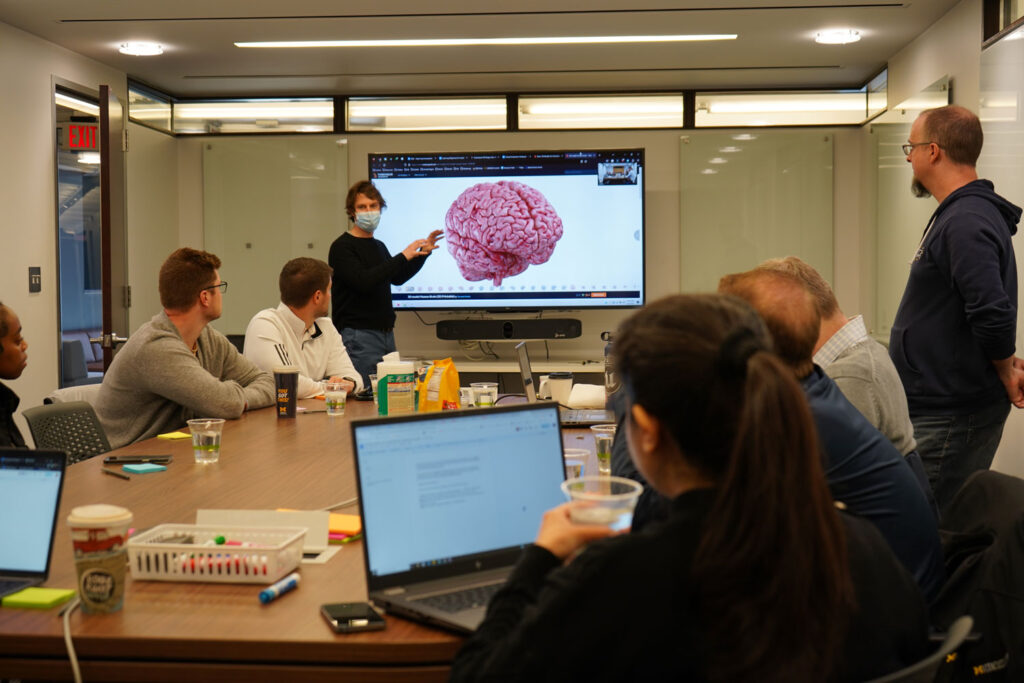
“Inside The Mind” was used in a special topics course led by Broglio during fall 2024 and winter 2025 semesters. The survey results of the VR experience indicated high user engagement and competence.
Survey Results
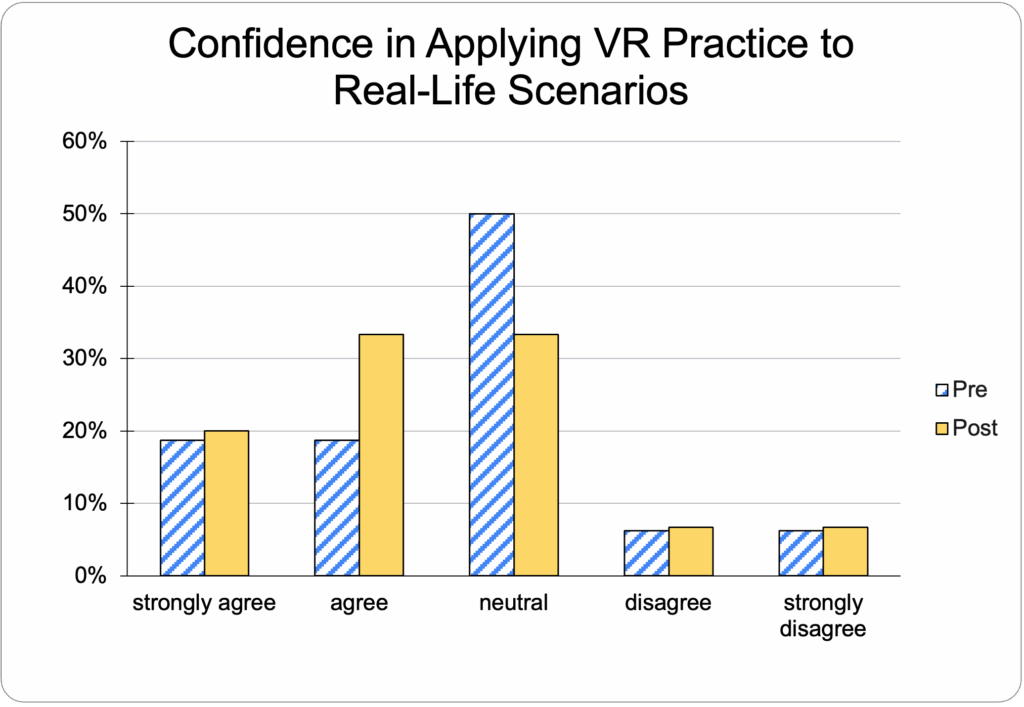
After using the VR application, students reported more confidence in applying the skills to apply the SCAT6 after the VR experience; “agree” and “strongly agree” ratings collectively increased from 38% to 53%. Student impressions echoed the data, saying that VR was more memorable and engaging than reading a textbook or watching a video.
Faciliated vs. Independent Use
After user testing across multiple projects, CAI found that integrating a VR module into class sessions, along with faculty guidance, produced far better engagement than directing students to use the VR experiences on their own. Whether students were new or experienced users of VR, faculty were able to provide personalized guidance that the experience couldn’t deliver alone. With this project and others before, CAI provided faculty with personalized training on how best to facilitate a VR experience with their students, ensuring that each experience was properly contextualized.
“The partnership between CAI and the Michigan Concussion Center has been exceptional,” said Broglio. “We came in with a vague and amorphous idea and they helped us solidify our concept into a workable model.”
What’s Next?
Broglio said the module continues to be used in courses, and the instructional team has been invited to present it at the North American Brain Injury Society and International Brain Injury Association in spring 2026.
“We hope others will find it useful,” Broglio said.
The XR Team is continuing to explore the integration of emerging technologies, such as AI, into XR experiences.
“I’m excited to continue learning how different fields can benefit from the expanding capabilities of emerging technology such as AR and generative AI,” said Eric Schreffler, XR developer lead at CAI. “I’m particularly interested in finding more ways that these technologies can assist the aging population.”
Amanda Cowell, experiential technologies project manager at CAI, also shared her enthusiasm for the direction of technology in education.
“Collaborations like these help us pilot and explore what is possible with XR and serve as a launching point for integrating with other emerging technologies, like AI. I believe they will also enhance immersive learning, and inform how we scale these experiences to support more faculty and reach more learners,” said Cowell.
Resources
Sport concussion assessment tool™ – 6 (SCAT6)
References
Merchant, Z., Goetz, E. T., Cifuentes, L., Keeney-Kennicutt, W., & Davis, T. J. (2014). Effectiveness of virtual reality-based instruction on students’ learning outcomes in K-12 and higher education: A meta-analysis. Computers and Education, 70, 29–40.
Paxinou, E., Panagiotakopoulos, C. T., Karatrantou, A., Kalles, D., & Sgourou, A. (2020). Implementation and Evaluation of a Three‐Dimensional Virtual Reality Biology Lab versus Conventional Didactic Practices in Lab Experimenting with the Photonic Microscope. Biochemistry and Molecular Biology Education, 48(1), 21–27.
Burke, D., Crompton, H., & Nickel, C. (2025). The Use of Extended Reality (XR) in Higher Education: A Systematic Review. TechTrends.